
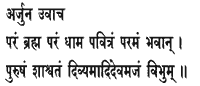
Arjuna said: Thou art the supreme Brahman, the supreme Abode, the supreme Purity, the one permanent, the divine Purusha, the original Godhead, the Unborn, the all-pervading Lord.
The Vision of the World-Spirit - The Double Aspect
Sri Aurobindo
EVEN WHILE the effects of the terrible aspect of this vision are still upon him, the first words uttered by Arjuna after the Godhead has spoken are eloquent of a greater uplifting and reassuring reality behind this face of death and this destruction. “Rightly and in good place,” he cries, “O Krishna, does the world rejoice and take pleasure in thy name, the Rakshasas are fleeing from thee in terror to all the quarters and the companies of the Siddhas bow down before thee in adoration. How should they not do thee homage, O great Spirit? For thou art the original Creator and Doer of works and greater even than creative Brahma. O thou Infinite, O thou Lord of the gods, O thou abode of the universe, thou art the Immutable and thou art what is and is not and thou art that which is the Supreme. Thou art the ancient Soul and the first and original Godhead and the supreme resting-place of this All; thou art the knower and that which is to be known and the highest status; O infinite in form, by thee was extended the universe. Thou art Yama and Vayu and Agni and Soma and Varuna and Prajapati, father of creatures, and the great-grandsire. Salutation to thee a thousand times over and again and yet again salutation, in front and behind and from every side, for thou art each and all that is. Infinite in might and immeasurable in strength of action thou pervadest all and art every one.” But this supreme universal Being has lived here before him with the human face, in the mortal body, the divine Man, the embodied Godhead, the Avatar, and till now he has not known him. He has seen the humanity only and has treated the Divine as
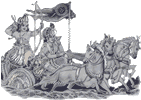
a mere human creature. He has not pierced through the earthly mask to the Godhead of which the humanity was a vessel and a symbol, and he prays now for that Godhead’s forgiveness of his unseeing carelessness and his negligent ignorance. “For whatsoever I have spoken to thee in rash vehemence, thinking of thee only as my human friend and companion, ‘O Krishna, O Yadava, O comrade,’ not knowing this thy greatness, in negligent error or in love, and for whatsoever disrespect was shown by me to thee in jest, on the couch and the seat and in the banquet, alone or in thy presence, I pray forgiveness from thee the immeasurable. Thou art the father of all this world of the moving and unmoving; thou art one to be worshipped and the most solemn object of veneration. None is equal to thee, how then another greater in all the three worlds, O incomparable in might? Therefore I bow down before thee and prostrate my body and I demand grace of thee the adorable Lord. As a father to his son, as a friend to his friend and comrade, as one dear with him he loves, so shouldst thou, O Godhead, bear with me. I have seen what never was seen before and I rejoice, but my mind is troubled with fear. O Godhead, show me that other form of thine. I would see thee even as before crowned and with thymace and discus. Assume thy four-armed shape, O thousand-armed, O Form universal.” From the first words there comes the suggestion that the hidden truth behind these terrifying forms is a reassuring, a heartening and delightful truth. There is something that makes the heart of the world to rejoice and take pleasure in the name and nearness of the Divine. It is the profound sense of that which makes us see in the dark face of Kali the face of the Mother and to perceive even in the midst of destruction the protecting arms of the Friend of creatures, in the midst of evil the presence of a pure unalterable Benignity and in the midst of death the Master of Immortality. From the terror of the King of the divine action the Rakshasas, the fierce giant powers of darkness, flee destroyed, defeated and overpowered. But the Siddhas, but the complete and perfect who know and sing the names of the Immortal and live in the truth of his being, bow down before every form of Him and know what every form enshrines and signifies. Nothing has real need to fear except that which is to be destroyed, the evil, the ignorance, the veilers in Night, the Rakshasa powers. All the movement and action of Rudra the Terrible is towards perfection and divine light and completeness. For this Spirit, this Divine is only in outward form the Destroyer, Time who undoes all these finite forms: but in himself he is the Infinite, the Master of the cosmic Godheads, in whom the world and all its action are securely seated. He is the original and ever originating Creator, one greater than that figure of creative Power called Brahma which he shows to us in the form of things as one aspect of his trinity, creation chequered by a balance of preservation and destruction. The real divine creation is eternal; it is the Infinite manifested sempiternally in finite things, the Spirit who conceals and reveals himself for ever in his innumerable infinity of souls and in the wonder of their actions and in the beauty of their forms. He is the eternal Immutable; he is the dual appearance of the Is and Is-not, of the manifest and the never manifested, of things that were and seem to be no more, are and appear doomed to perish, shall be and shall pass. But what he is beyond all these is That, the Supreme, who holds all things mutable in the single eternity of a Time to which all is ever present. He possesses his immutable self in a timeless eternity of which Time and creation are an ever extending figure. This is the Truth of him in which all is reconciled; a harmony of simultaneous and interdependent truths start from and amount to the one that is real. It is the truth of a supreme Soul of whose supreme nature the world is a derivation and an inferior figure of that Infinite; of the Ancient of Days who for ever presides over the long evolutions of Time; of the original Godhead of whom Gods and men and all living creatures are the children, the powers, the souls, spiritually justified in their being by his truth of existence; of the Knower who develops in man the knowledge of himself and world and God; of the one Object of all knowing who reveals himself to man’s heart and mind and soul, so that every new opening form of our knowledge is a partial unfolding of him, up to the highest by which he is intimately, profoundly and integrally seen and discovered. This is the high supreme Stability who originates and supports and receives to himself all that are in the universe. By him in his own existence the world is extended, by his omnipotent power, by his miraculous self-conception and energy and Ananda of neverending creation. All is an infinity of his material and spiritual forms. He is all the many gods from the least to the greatest; he is the father of creatures and all are his children and his people. He is the origin of Brahma, the father to the first father of the divine creators of these different races of living things. On this truth there is a constant insistence. Again it is repeated that he is the All, he is each and every one, sarvah. . He is the infinite Universal and he is each individual and everything that is, the one Force and Being in every one of us, the infinite Energy that throws itself out in these multitudes, the immeasurableWill and mighty Power of motion and action that forms out of itself all the courses of Time and all the happenings of the spirit in Nature. And from that insistence the thought naturally turns to the presence of this one great Godhead in man. There the soul of the seer of the vision is impressed by three successive suggestions. First, it is borne in upon him that in the body of this son ofMan who moved beside him as a transient creature upon earth and sat by his side and lay with him on the same couch and ate with him in the banquet and was the object of jest and careless word, actor in war and council and common things, in this figure of mortal man was all the time something great, concealed, of tremendous significance, a Godhead, an Avatar, a universal Power, a One Reality, a supreme Transcendence. To this occult divinity in which all the significance ofman and his long race is wrapped and from which all world-existence receives its inner meaning of ineffable greatness, he had been blind. Now only he sees the universal Spirit in the individual frame, the Divine embodied in humanity, the transcendent Inhabitant of this symbol of Nature. He has seen now only this tremendous, infinite, immeasurable Reality of all these apparent things, this boundless universal Form which so exceeds every individual form and yet of whom each individual thing is a house for his dwelling. For that great Reality is equal and infinite and the same in the individual and in the universe. And at first his blindness, his treatment of this Divine as the mere outward man, his seeing of only the mental and physical relation seems to him a sin against the Mightiness that was there. For the being whom he called Krishna, Yadava, comrade, was this immeasurable Greatness, this incomparableMight, this Spirit one in all of whom all are the creations. That and not the veiling outward humanity, avaja¯nan ma¯nus.ı¯m˙ tanum a¯s´ritam, was what he should have seen with awe and with submission and veneration. But the second suggestion is that what was figured in the human manifestation and the human relation is also a reality which accompanies and mitigates for our mind the tremendous character of the universal vision. The transcendence and cosmic aspect have to be seen, for without that seeing the limitations of humanity cannot be exceeded. In that unifying oneness all has to be included. But by itself that would set too great a gulf between the transcendent spirit and this soul bound and circumscribed in an inferior Nature. The infinite presence in its unmitigated splendour would be too overwhelming for the separate littleness of the limited, individual and natural man. A link is needed by which he can see this universal Godhead in his own individual and natural being, close to him, not only omnipotently there to govern all he is by universal and immeasurable Power, but humanly figured to support and raise him to unity by an intimate individual relation. The adoration by which the finite creature bows down before the Infinite, receives all its sweetness and draws near to a closest truth of companionship and oneness when it deepens into the more intimate adoration which lives in the sense of the fatherhood of God, the friendhood of God, the attracting love between the Divine Spirit and our human soul and nature. For the Divine inhabits the human soul and body; he draws around him and wears like a robe the human mind and figure. He assumes the human relations which the soul affects in the mortal body and they find in God their own fullest sense and greatest realisation. This is the Vaishnava bhakti of which the seed is here in the Gita’s words, but which received afterwards a more deep, ecstatic and significant extension. And from this second suggestion a third immediately arises. The form of the transcendent and universal Being is to the strength of the liberated spirit a thing mighty, encouraging and fortifying, a source of power, an equalising, sublimating, alljustifying vision; but to the normal man it is overwhelming, appalling, incommunicable. The truth that reassures, even when known, is grasped with difficulty behind the formidable and mighty aspect of all-destructive Time and an incalculable Will and a vast immeasurable inextricable working. But there is too the gracious mediating form of divine Narayana, the God who is so close to man and in man, the Charioteer of the battle and the journey, with his four arms of helpful power, a humanised symbol of Godhead, not this million-armed universality. It is this mediating aspect which man must have for his support constantly before him. For it is this figure of Narayana which symbolises the truth that reassures. It makes close, visible, living, seizable the vast spiritual joy in which for the inner spirit and life of man the universal workings behind all their stupendous circling, retrogression, progression sovereignly culminate, their marvellous and auspicious upshot. To this humanised embodied soul their end becomes here a union, a closeness, a constant companionship of man and God, man living in the world for God, God dwelling in man and turning to his own divine ends in him the enigmatic world-process. And beyond the end is a yet more wonderful oneness and inliving in the last transfigurations of the Eternal. The Godhead in answer to Arjuna’s prayer reassumes his own normal Narayana image, svakam˙ ru¯pam, the desired form of grace and love and sweetness and beauty. But first he declares the incalculable significance of the other mighty Image which he is about to veil. “This that thou now seest,” he tells him, “is my supreme shape, my form of luminous energy, the universal, the original which none but thou amongst men has yet seen. I have shown it by my self-Yoga. For it is an image of my very Self and Spirit, it is the very Supreme self-figured in cosmic existence and the soul in perfect Yoga with me sees it without any trembling of the nervous parts or any bewilderment and confusion of the mind, because he descries not only what is terrible and overwhelming in its appearance, but also its high and reassuring significance. And thou also shouldst so envisage it without fear, without confusion ofmind, without any sinking of themembers; but since the lower nature in thee is not yet prepared to look upon it with that high strength and tranquillity, I will reassume again for thee my Narayana figure in which the human mind sees isolated and toned to its humanity the calm, helpfulness and delight of a friendly Godhead. The greater Form”—and this is repeated again after it has disappeared—“is only for the rare highest souls. The gods themselves ever desire to look upon it. It cannot be won by Veda or austerities or gifts or sacrifice; it can be seen, known, entered into only by that bhakti which regards, adores and loves Me alone in all things.” But what then is the uniqueness of this Form by which it is lifted so far beyond cognizance that all the ordinary endeavour of human knowledge and even the inmost austerity of its spiritual effort are insufficient, unaided, to reach the vision? It is this that man can know by other means this or that exclusive aspect of the one existence, its individual, cosmic or worldexcluding figures, but not this greatest reconciling Oneness of all the aspects of the Divinity in which at one and the same time and in one and the same vision all is manifested, all is exceeded and all is consummated. For here transcendent, universal and individual Godhead, Spirit and Nature, Infinite and finite, space and time and timelessness, Being and Becoming, all that we can strive to think and know of the Godhead, whether of the absolute or themanifested existence, are wonderfully revealed in an ineffable oneness. This vision can be reached only by the absolute adoration, the love, the intimate unity that crowns at their summit the fullness of works and knowledge. To know, to see, to enter into it, to be one with this supreme form of the Supreme becomes then possible, and it is that end which the Gita proposes for its Yoga. There is a supreme consciousness through which it is possible to enter into the glory of the Transcendent and contain in him the immutable Self and all mutable Becoming,— it is possible to be one with all, yet above all, to exceed world and yet embrace the whole nature at once of the cosmic and the supracosmic Godhead. This is difficult indeed for limited man imprisoned in his mind and body: but, says the Godhead, “be a doer of my works, accept me as the supreme being and object, become my bhakta, be free from attachment and without enmity to all existences; for such a man comes to me.” In other words superiority to the lower nature, unity with all creatures, oneness with the cosmic Godhead and the Transcendence, oneness of will with the Divine in works, absolute love for the One and for God in all,—this is the way to that absolute spiritual self-exceeding and that unimaginable transformation.
Sri Aurobindo
 About Us | ©1999 - 2009 searchforlight.org
All extracts and quotations from the written works of Sri Aurobindo and the Mother and the Photographs of
the Mother and Sri Aurobindo are copyright Sri Aurobindo Ashram Trust, Pondicherry -605002 India.